
Beyond whether the session happened
A completed ride tells you an athlete did the work. It doesn't tell you what the work cost them. Open a cycling activity's review page and click Advanced analysis for the two views that answer that, both built on the athlete's own power profile.
For now, this view is still mostly focused on cycling, because it depends on power, but we plan to add graphs for other sports in the future as well. In total, this complements the global workout review page covered in Reviewing a workout.
Power vs reserve
Every athlete has a finite amount of work available above critical power, and once it's gone the efforts stop landing. Power vs reserve plots the ride against that: their critical power and W′ from a rolling three-month profile, the work spent above CP, and how much reserve was left at any moment.
The number to look at is the lowest reserve of the session. An interval set that leaves the athlete at 31% has genuinely taxed them. One that never drops below 80% was easier than the plan intended, whatever the average power says, and that's the session worth rewriting before you prescribe it again.
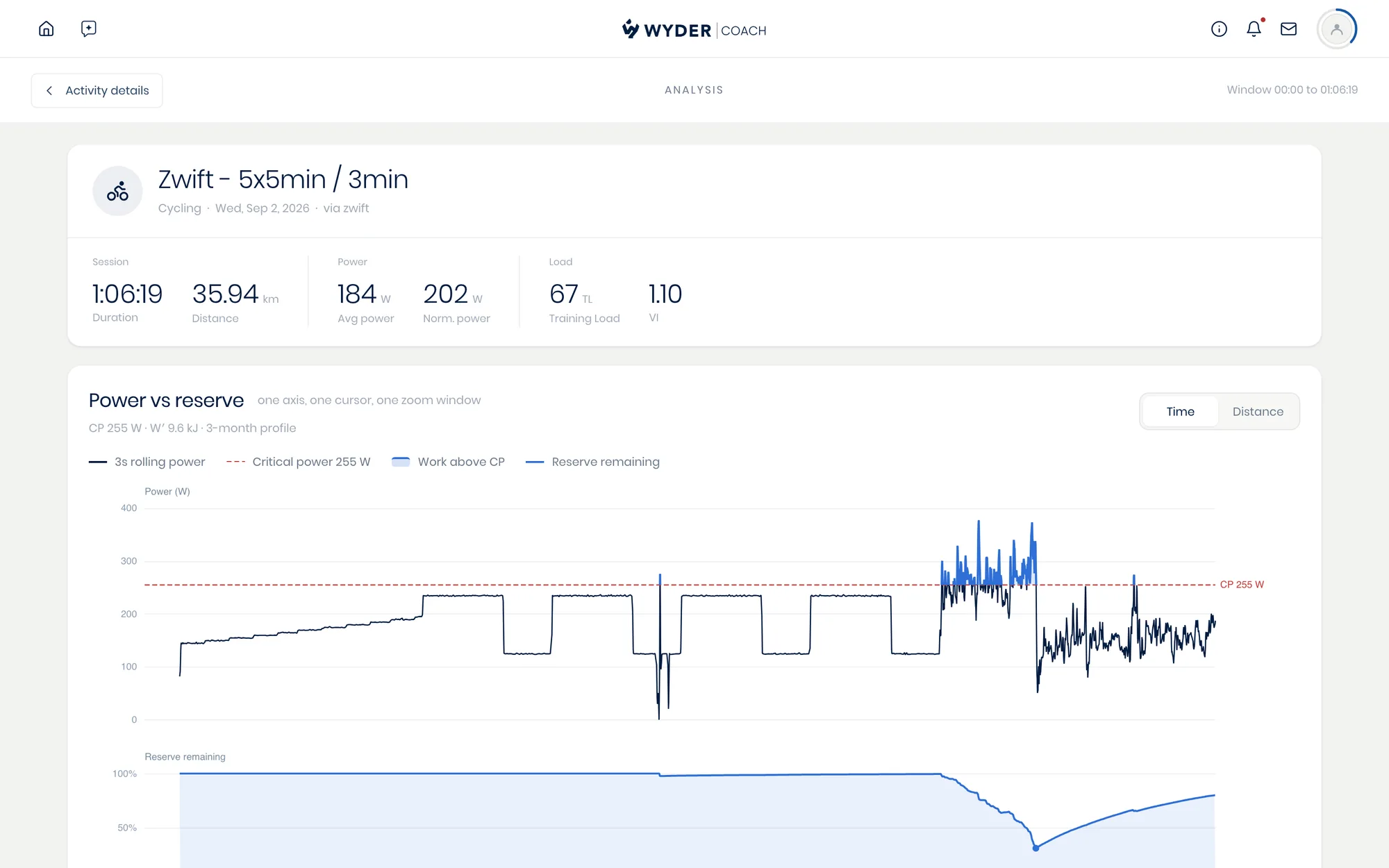
Drag across either graph to select a region and the numbers recompute for just that window, so you can read one interval rather than a whole-ride average.
Power range exposure
The second view answers a narrower question: how long was this athlete actually in the range you were aiming at? Set the range by anchor, at VO₂max or as a percentage of FTP, drag the two amber lines to the band you care about, and it returns the time spent inside it and what share of the ride that was.
That turns "was this a threshold session" from a judgement into a number. Twenty-one minutes between 90 and 100% of FTP is a threshold session. Six minutes is a ride with some hard bits in it.