This is a guest post by Sean Seville, founder and head coach of DM Running Team, a Canadian-founded endurance coaching community that coaches its athletes on Wyder.
Who we are
DM Running Team is a Canadian-founded endurance coaching community supporting athletes worldwide. We exist to create opportunities for athletes with exceptional potential, because access to coaching, mentorship and competition can make the difference. Our mission is to make high-quality coaching accessible to runners of all abilities and backgrounds, from first-time runners to elite competitors.
Three values define us: Gratitude First. Forward Focus. Lifting Others. They stand for our appreciation for the journey, our commitment to continuous improvement, and our belief that the greatest achievements become even more meaningful when we help others succeed.
The coaching team reflects that range. Terry Arsenault has coached since 2002 and ran 2:55 at the Chicago Marathon this year at age 46. Harold Emas coaches long-distance running and leads our community. Nicholas Mwiti trains at altitude on Mount Kenya while he prepares for the Boston Marathon.
Our coaching runs on one system. We call it The Formula: our performance methodology built around individual physiology, training adaptation and sustainable progression.
This article walks you through it the way an athlete lives it, one week at a time. By the end you will know the one thing every session is aiming at, the three sessions that get you there, and how the week grows as you do.
The goal: a faster pace you can hold
A marathon rewards the runner who can hold a fast pace for a very long time. So The Formula has one objective: increase the speed an athlete can sustainably maintain, while preserving their ability to recover and adapt.
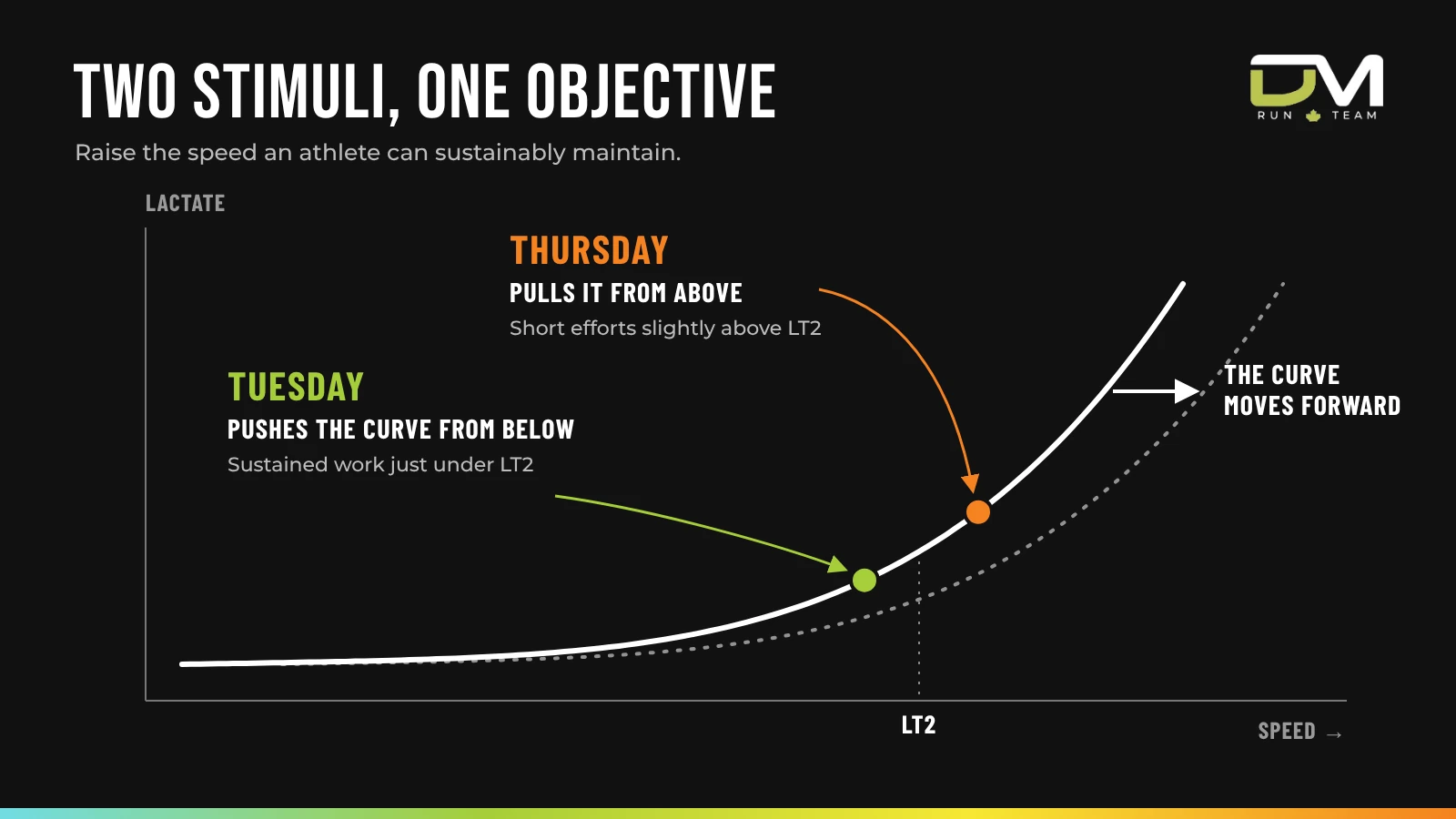
The picture we coach from is the lactate curve. At easy speeds, lactate stays low. As speed rises it climbs, and past the second lactate threshold, LT2, it builds faster than the body can clear it. Above that point, prolonged efforts become increasingly difficult to sustain as metabolic strain, ventilation and fatigue progressively increase.
Raising your sustainable speed means moving that whole curve forward, so the pace that once sat at your limit sits comfortably below it. The week is designed to do exactly that, and it follows one guiding principle: Minimum Effective Stimulus. Maximum Sustainable Consistency. We believe extraordinary performance comes from intelligently balancing physiological development, progressive workload and recovery, allowing athletes to build sustainable performance over time. Put simply:
The goal isn't simply to train harder. It's to increase the amount of quality training an athlete can consistently absorb.
With that in mind, here is the week.
Step one, Tuesday: push the curve from below
The first key session of the week is Lactate Threshold Durability, one of our signature marathon development workouts. The structure is a ten-minute block: eight minutes of controlled threshold running, two minutes of active recovery, and repeat.
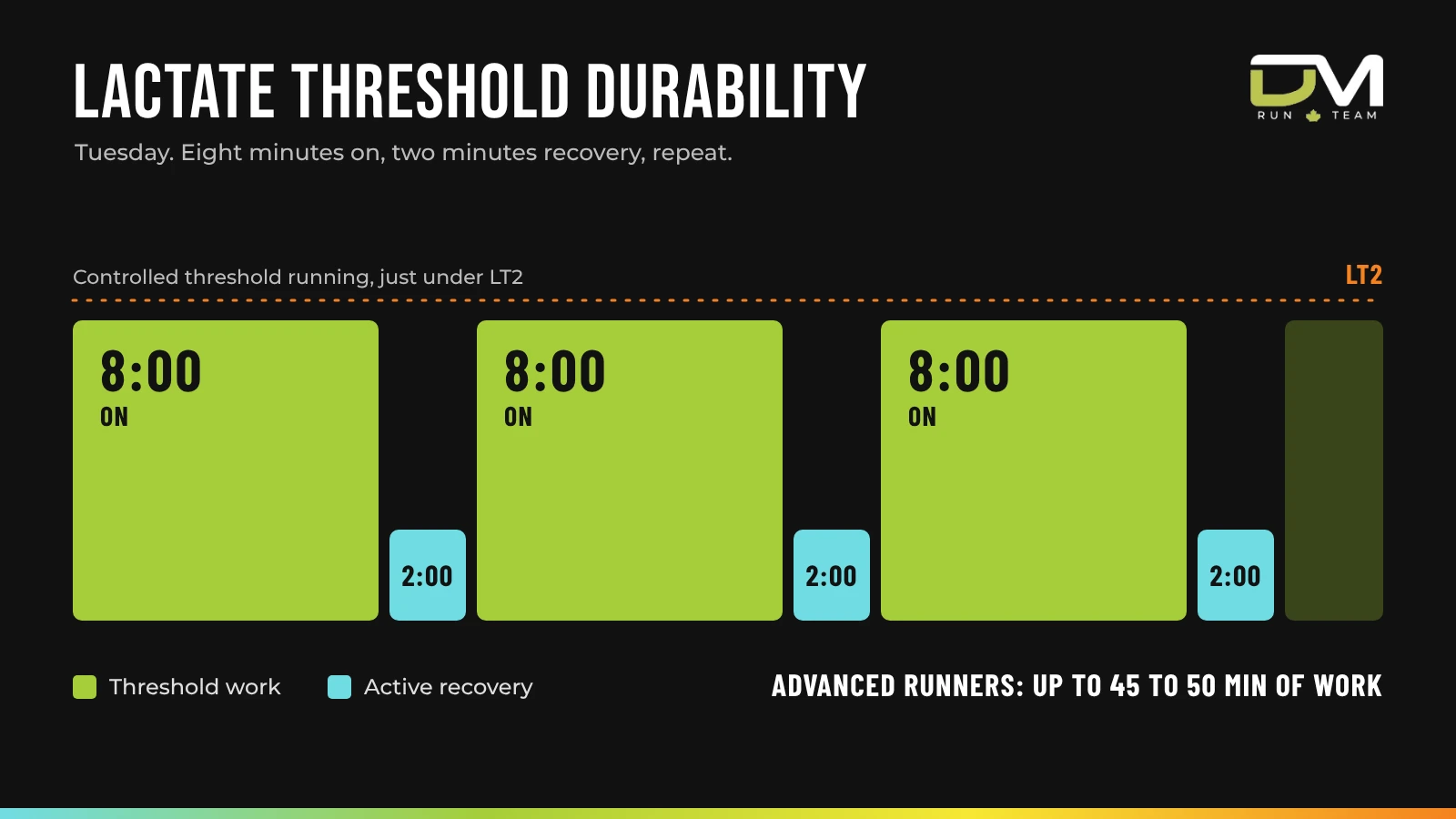
The detail that matters is where the effort sits. We deliberately prescribe it slightly below the athlete's estimated LT2. That lets us accumulate sustained threshold exposure and develop the body's ability to transport and use lactate as fuel, without creating excessive physiological fatigue. Staying just under the line is what makes the volume of quality work possible, and it leaves the athlete ready for what comes two days later.
It is simple to follow and precise in execution. It is also particularly useful during Canadian winters, because the ten-minute structure translates beautifully to treadmill training.
Tuesday works on the curve from one side. Thursday comes at it from the other.
Step two, Thursday: pull the curve from above
Thursday is our Kenyan Float Fartlek. It introduces shorter efforts slightly above LT2, alternating with purposeful aerobic floats.
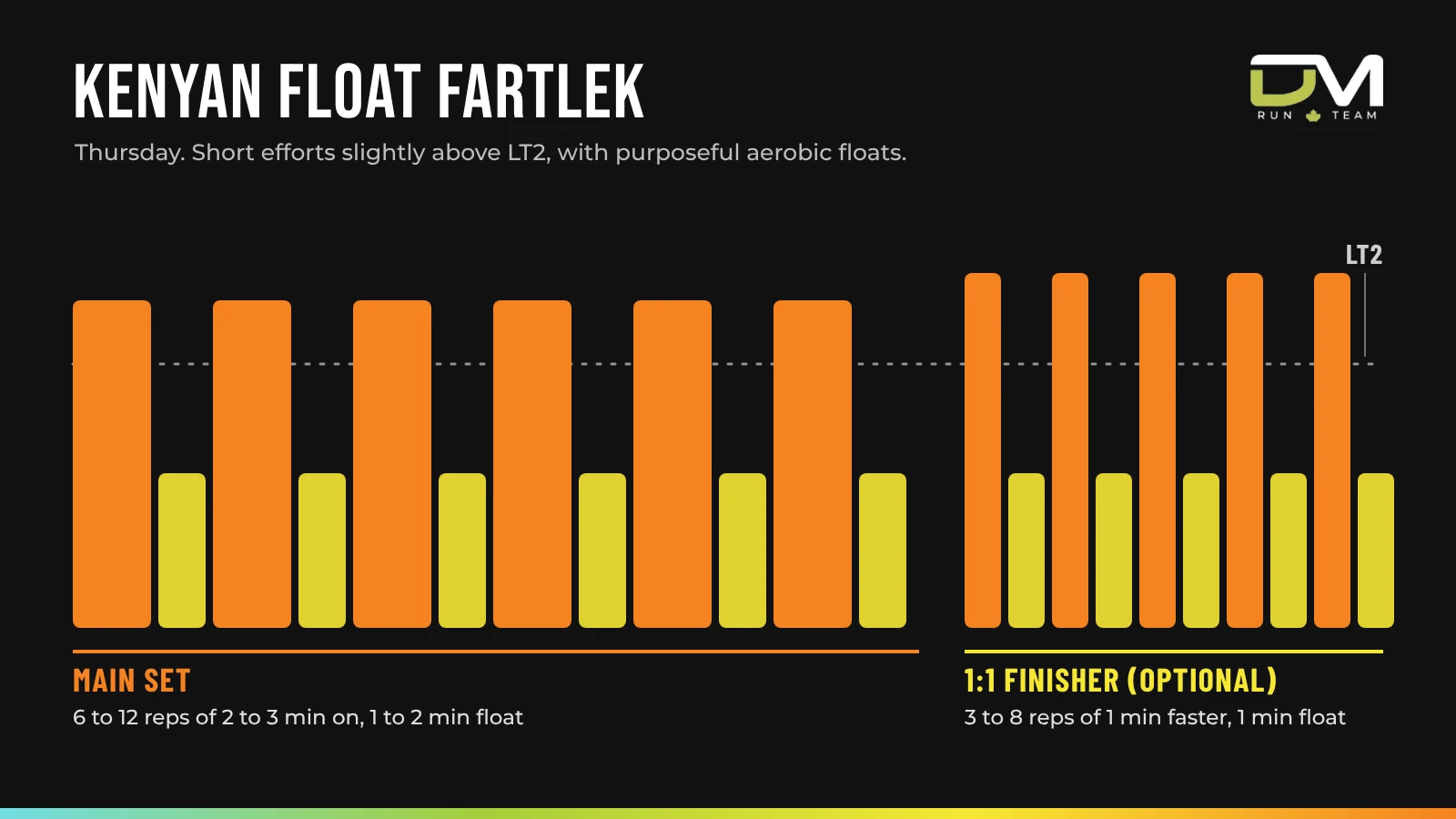
Because the faster intervals are relatively short, the lactate response develops progressively. That allows us to introduce higher speeds while managing the overall metabolic demand, which keeps the session inside that principle.
The structure follows The Formula's established progression:
- Main set: typically 6 to 12 repetitions of 2 to 3 minutes on, with purposeful aerobic floats of 1 to 2 minutes, depending on the athlete's development phase.
- 1:1 finisher: an optional, shorter extension of 1 minute faster running and 1 minute float. Typically 3 to 8 repetitions, scaled to the main set, the training phase and the athlete's readiness.
- Individualisation: total duration, intensity and recovery are adjusted according to physiological response, accumulated fatigue and training objectives.
The finisher reinforces economical turnover under fatigue. It stays controlled: there is no sprinting and no forcing of unnecessary volume.
This is where The Formula comes together. Tuesday develops threshold durability, effectively pushing the lactate curve forward from below. Thursday introduces controlled faster running, pulling the curve forward from above. Two complementary training stimuli, one objective.
Step three, the weekend: make it last
A curve that has moved forward still has to be carried over the full marathon distance. That is the job of the weekend long run. It completes the training architecture, translating the physiological development from Tuesday and Thursday into aerobic durability and marathon-specific endurance.
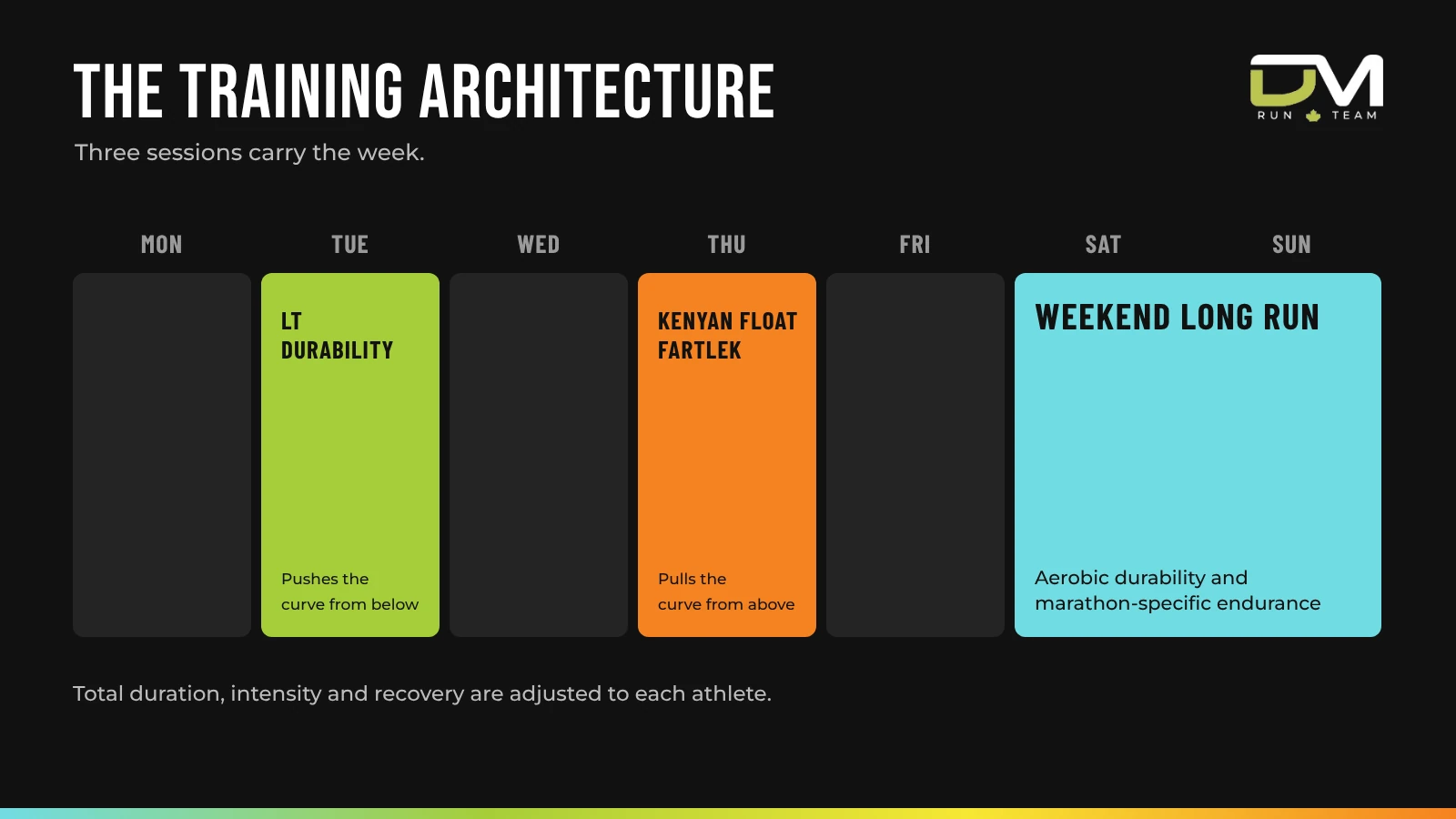
Three sessions, each with one job, all pointed at the same goal. That is one week. The next question is how the week changes as the athlete does.
Then the week grows with you
As athletes adapt, we progressively extend the accumulated threshold exposure on Tuesday. Advanced runners can reach 45 to 50 minutes of controlled work in a single session.
For select high-performance athletes with sufficient training history, volume and recovery capacity, Norwegian-inspired double threshold training may eventually provide an additional progression.
The principle stays the same at every stage: we add quality work only as fast as the athlete can absorb it.
And it starts from your own numbers
Everything above depends on knowing where an athlete's thresholds are. We have recently introduced blood lactate testing to better estimate each athlete's LT1 and LT2. It refines our pace and heart rate prescriptions, so "just under LT2" means something specific for every runner we coach.
This is also where our tools matter. As we grow, we need technology that supports the complex decisions behind every athlete's training while keeping the experience simple and accessible. Wyder lets us translate The Formula into structured workouts delivered directly to our athletes' Garmin and Suunto devices, and connect physiological testing, structured workouts and ongoing performance analysis.
What sets Wyder apart most is their willingness to listen, learn and grow alongside experienced coaches and knowledgeable athletes. Great coaching is personal, and great innovation begins with listening. We are proud to be growing alongside them.
The Formula in one line
Push the curve from below on Tuesday, pull it from above on Thursday, make it last at the weekend, and grow the work only as fast as you can absorb it. Week after week, that is how the pace you can hold gets faster.
The bigger picture: The Formula as a book
This article covers one week. The full methodology is coming as a book: THE FORMULA: The Science of Endurance. The Art of Becoming Extraordinary will be released on Amazon in early 2027.
It expands on everything above, exploring the science of endurance, intelligent training progression, injury risk management and the mindset required to pursue extraordinary goals. Our ambition is to make evidence-informed endurance training accessible to athletes worldwide, from first-time runners to elite competitors.
Train with DM Running
If you want The Formula applied to your own training:
- See our coaching programs, Foundation and Performance.
- Get in touch through the site, or email us at hello@dmrunning.com.
- Follow the team on Instagram at @dm.running.team.
- For more on Kenyan-style training, see the recommended reading on our site.